
Addressable vs Conventional Fire Alarm System: Which Is Better?
A clear comparison of addressable vs conventional fire alarm systems, covering how each works, key differences in detection, wiring, cost, scalability, maintenance, and which system is better suited for different types of buildings.
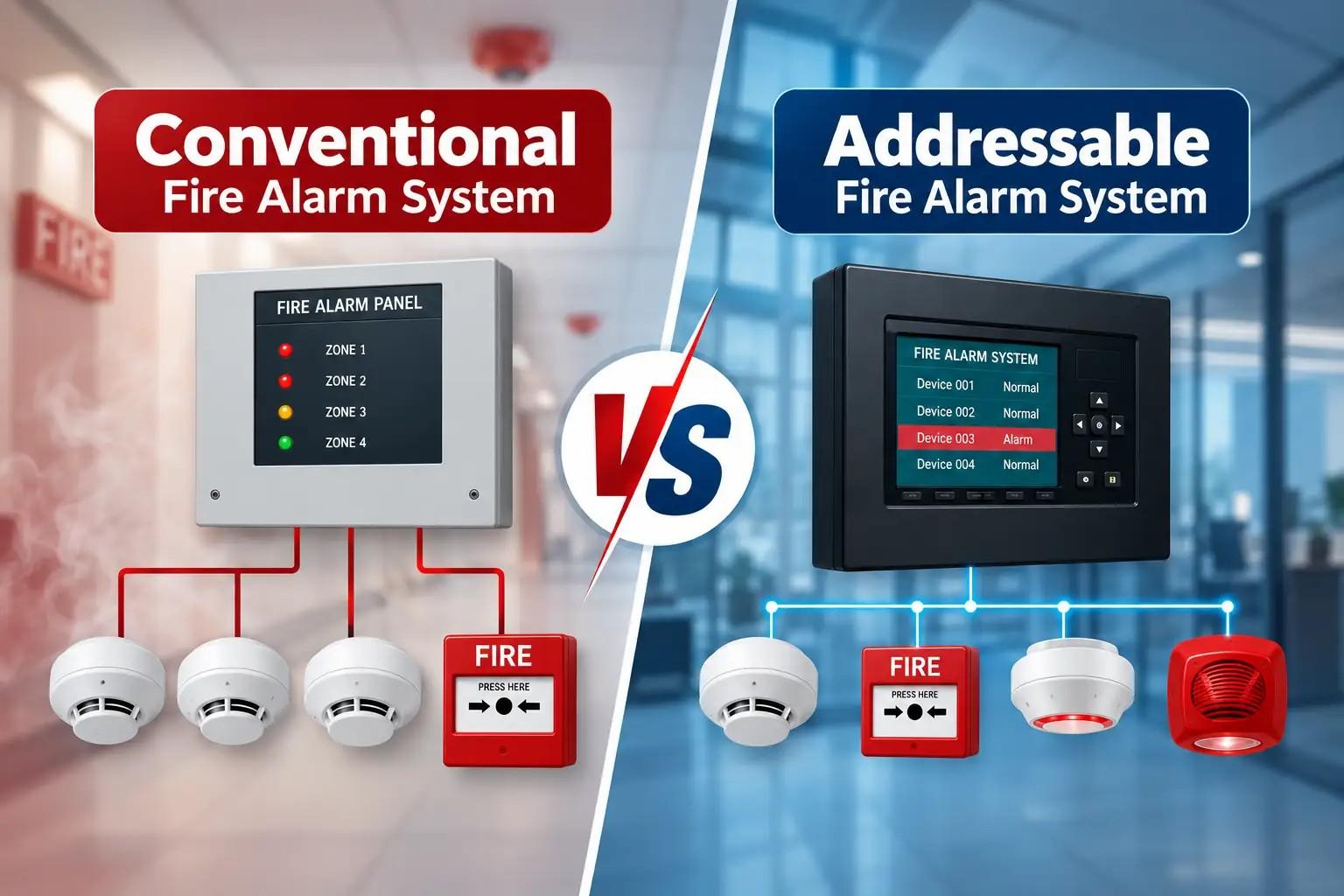
Selecting the right fire alarm system is an engineering decision that depends on the size and complexity of the building, required alarm-location accuracy, wiring architecture, number of detection devices, scalability, maintenance requirements and project budget.
The main difference when comparing an addressable vs conventional fire alarm system is how field devices communicate with the control panel. A conventional system groups detectors and manual call points into zones, while an addressable system assigns individual identities to compatible devices, allowing the panel to identify the exact detector or module generating an event.
Both technologies can provide reliable fire detection when properly designed, installed and maintained. Therefore, the choice between a conventional vs addressable fire alarm system should be based on system requirements rather than assuming one technology is suitable for every building.
Safelincs provides complete fire alarm systems and smoke detection equipment for different residential, commercial and industrial applications.
Addressable vs Conventional Fire Alarm System: Quick Comparison
Feature | Conventional Fire Alarm | Addressable Fire Alarm |
Fire location | Zone-level identification | Exact device/location |
System architecture | Separate detection zones | Addressable loop architecture |
Device identification | No individual address | Unique device address |
Initial equipment cost | Generally lower | Generally higher |
Wiring architecture | Zone-based radial circuits | Loop/SLC-based circuits |
Scalability | Limited by panel zones | High, subject to loop capacity |
Fault detection | Circuit/zone level | Device and loop level |
Expansion | May require new zones/cabling | Easier within available capacity |
Maintenance | More manual diagnosis | Detailed diagnostic information |
Programming | Basic | Advanced logic possible |
Integration | Limited | Greater integration capability |
Best suited for | Smaller/simple buildings | Medium-large/complex buildings |
The biggest technical difference is zone-level identification versus device-level identification.
A conventional panel may indicate “Fire Zone 2”, whereas an addressable panel may identify “Smoke Detector 024 Second Floor Server Room.” This additional location information becomes increasingly valuable as the number of detectors and protected areas increases.
What Is a Conventional Fire Alarm System?
A conventional fire alarm system divides a protected building into separate detection zones. Smoke detectors, heat detectors and manual call points within a defined area are electrically connected to the corresponding zone input of the conventional fire alarm control panel.
The control panel supervises each detection circuit for changes in electrical condition. Depending on the equipment design, an end-of-line resistor or other end-of-line component allows the panel to distinguish normal circuit conditions from alarm, open-circuit and fault conditions.
When a detector activates or a manual call point is operated, the electrical state of the zone changes. The panel recognises this condition and identifies the affected zone, but generally cannot determine which individual detector on that zone generated the alarm.
Safelincs offers different conventional fire alarm control panels with multiple zone capacities for different installation requirements.
How Does a Conventional Fire Alarm System Work?
The basic signal path is:
Detector / Manual Call Point → Zone Circuit → Fire Alarm Control Panel → Alarm Processing → Sounder Circuit → Notification
The control panel continuously monitors each detection zone. Under normal operation, the circuit remains within its specified electrical range.
When a compatible smoke detector, heat detector or manual call point changes the circuit condition, the control panel recognises an alarm state and activates configured notification outputs.
For example:
Zone 1 → Ground Floor
Zone 2 → First Floor
Zone 3 → Second Floor
Zone 4 → Electrical/Plant Area
If one of several detectors connected to Zone 3 activates, the panel generally displays the Zone 3 alarm. Personnel must then inspect the affected zone to locate the individual initiating device.
Advantages of Conventional Fire Alarm Systems
Conventional systems generally offer a lower initial equipment cost and relatively straightforward architecture. They are particularly practical where only a limited number of fire detection zones are required.
Their simpler configuration can also make operation straightforward for smaller premises where the affected zone can be physically inspected quickly.
For basic applications, conventional systems provide an effective combination of:
simple zone-based architecture
relatively low initial cost
straightforward operation
compatibility with conventional detection devices
basic fire and fault supervision
Limitations of Conventional Fire Alarm Systems
The primary limitation is that alarm information is normally available only at the zone level.
If ten detectors are connected to one zone, the panel cannot generally identify which of those ten detectors activated. Maintenance personnel may therefore need to inspect multiple devices when diagnosing an alarm or fault.
Expansion can also become more difficult because system capacity depends heavily on the number of available zone inputs, notification circuits, panel power capacity and existing cable infrastructure.
Safelincs also supplies compatible conventional smoke and heat detectors and conventional manual call points and alarm devices for conventional fire alarm installations.
What Is an Addressable Fire Alarm System?
An addressable fire alarm system uses individually identifiable field devices connected to an addressable communication circuit, commonly described as a loop or Signalling Line Circuit (SLC) depending on the manufacturer.
Each compatible detector, manual call point, input module, output module or other field device receives a unique address.
Instead of monitoring only the overall electrical state of a zone, the addressable fire alarm control panel communicates with individual devices over the loop. This allows the panel to determine which specific device generated an alarm, fault or other system event.
Depending on the fire alarm platform and detector capabilities, the panel may display information including:
Device Address → Device Type → Programmed Location → Device Status
For example: Device 037 - Optical Smoke Detector - Third Floor Electrical Room FIRE
Safelincs supplies addressable fire alarm panels for projects requiring loop-based detection and individual device identification.
How Does an Addressable Fire Alarm System Work?
The simplified communication path is:
Addressable Detector / MCP / Module → Addressable Loop → Control Panel → Device Identification → Cause-and-Effect Processing → Alarm Outputs
The control panel communicates with devices connected to the addressable circuit. Each device responds according to its assigned address and system protocol.
When an addressable detector reaches an alarm threshold, information is transmitted to the panel. The panel identifies the specific device and executes the programmed response.
Depending on the system configuration, that response may include:
Activate sounders → operate strobes → release fire doors → shut down HVAC → send monitoring signal → operate programmed control outputs
This ability to combine precise device identification with programmable system responses is one of the most important advantages of addressable technology.
Advantages of Addressable Fire Alarm Systems
Addressable systems provide more precise information because field devices can be individually identified.
This can provide:
exact alarm-device identification
improved fault diagnosis
detailed system event information
greater scalability
programmable cause-and-effect logic
easier integration with other building systems
more efficient troubleshooting
For detection applications, Safelincs also provides addressable smoke and heat detectors designed for compatible addressable fire alarm platforms.
Limitations of Addressable Fire Alarm Systems
Addressable equipment generally costs more initially because the control panel and individual devices contain more sophisticated communication electronics.
System configuration is also more technical. Engineers or technicians may need to configure device addresses, text descriptions, zones, loop assignments, control outputs and cause-and-effect logic.
Addressable devices are also protocol dependent. A detector from one manufacturer or product family cannot automatically be connected to another manufacturer's addressable panel without verifying protocol and system compatibility.
Key Differences Between Addressable and Conventional Fire Alarm Systems
1. Fire Location Identification
Location identification is the most obvious difference.
Conventional Fire Alarm: A conventional panel might report: FIRE ZONE 4
If eight detectors are installed on Zone 4, personnel may need to inspect the zone to determine which detector activated.
Addressable Fire Alarm: An addressable panel may report: FIRE DEVICE 041 - OPTICAL SMOKE DETECTOR ROOM 405
The individual device address therefore provides much more precise information.
In a small building, this difference may have limited operational impact. In a hotel, hospital, industrial facility or large commercial complex containing hundreds of detection devices, exact device identification can significantly improve alarm investigation.
2. System Architecture
Conventional Architecture: Conventional systems typically use radial detection circuits. For example:
Panel → Zone 1 circuit → detectors/MCPs → End-of-line
Panel → Zone 2 circuit → detectors/MCPs → End-of-line
Each zone is independently monitored by the panel.
3. Addressable Architecture
Addressable systems connect multiple individually identified devices over an addressable communication circuit. A simplified loop may be:
Panel → Detector 001 → Detector 002 → MCP 003 → Module 004 → Detector 005 → Isolator → Panel
The exact topology, maximum device count and permitted circuit arrangement depend on the manufacturer.
4. Wiring Requirements
Conventional installations may require separate cables for multiple:
detection zones
alarm sounder circuits
control circuits
auxiliary interfaces
As the number of zones increases, additional circuits normally need to terminate at the control panel.
Addressable systems allow numerous devices to communicate over common loops. However, engineers must still calculate and verify:
maximum loop length
conductor resistance
circuit capacitance
voltage drop
loop current
number of devices
isolator positioning
manufacturer limitations
It is therefore incorrect to state that addressable systems always use less cable. Actual cable requirements depend on building geometry, redundancy requirements, device distribution and system design.
5. Installation Cost
A technical cost comparison should consider the complete installed system, rather than comparing control-panel prices alone.
Conventional system costs depend on the number of zones, detectors, manual call points, sounder circuits, cable routes and installation labour.
Addressable system costs additionally depend on loop capacity, modules, isolators, addressable devices, system programming and commissioning requirements.
For a small building containing relatively few devices, a conventional system is usually more economical. In a larger installation, addressable architecture may provide operational benefits that justify its higher initial hardware cost.
6. Fault Detection and Troubleshooting
A conventional panel may display: FAULT ZONE 5
Technicians may then need to inspect multiple cable connections, detector bases, devices and the end-of-line component to determine the source.
An addressable panel may provide more specific diagnostic information such as: Device 073 Missing or Communication Fault Device 073
Certain addressable installations also use short-circuit isolators to reduce the number of devices affected by a cable short.
7. Expansion and Scalability
Conventional expansion depends heavily on available zone capacity. If an existing four-zone control panel already uses all four zones, expansion may require panel expansion hardware, an additional panel or replacement with a larger control panel.
Addressable systems may accommodate additional devices when adequate:
addresses
loop electrical capacity
panel processing capacity
power capacity
programming capacity
remain available.
Larger systems may also support multiple loops and networked fire alarm control panels.
8. Maintenance
Both conventional and addressable fire alarm systems require scheduled inspection, testing and preventive maintenance.
The difference lies mainly in diagnostic capability. Conventional systems generally provide circuit-level information, whereas compatible addressable equipment can provide device-level information that may make fault localisation more efficient.
Certain addressable detectors may also provide additional diagnostic information such as device communication status or detector-condition information where supported by the manufacturer.
9. Monitoring and Control
Conventional fire alarm systems typically provide basic fire, fault, zone and notification-circuit information. Addressable systems can provide significantly more detailed information and advanced control through programmable input/output modules.
For example: Sprinkler Flow Switch → Addressable Input Module → Fire Alarm Panel
The panel may then execute programmed actions such as: Fire Alarm Panel → Control Module → HVAC Shutdown
Addressable modules can also be used for interfaces involving fire doors, smoke dampers, access control, sprinkler monitoring and other building safety systems where the approved design requires such integration.
Safelincs provides addressable manual call points, modules, sounders and strobes for compatible fire alarm installations.
Addressable vs Conventional Fire Alarm System Cost
The final cost of a fire alarm system depends on several engineering variables rather than the price of the control panel alone.
Important factors include:
total protected area
number of floors
number of zones or loops
detector quantity
manual call point quantity
sounders and visual alarm devices
cable distances
power-supply requirements
backup battery capacity
interface modules
programming
labour
testing and commissioning
future expansion
For this reason, a proper quotation should ideally be prepared from system drawings, technical requirements or a bill of quantities.
Which One Is Cheaper?
A conventional system normally has a lower initial cost for a small installation because its control panels and field devices are simpler.
An addressable system normally has higher initial equipment and commissioning costs, but its device-level diagnostics, scalability and integration capability can provide significant operational advantages in larger buildings.
The comparison should therefore consider lifecycle cost, not only equipment purchase price.
Which Fire Alarm System Is Better for Different Buildings?
1. Small Shops and Offices
Conventional systems can be appropriate for smaller premises where there are relatively few detectors and each alarm zone can be inspected quickly. A 2-zone, 4-zone or similar conventional fire alarm panel may be suitable where the approved fire-safety design permits a simple zone-based system.
2. Hotels
Addressable systems are generally more suitable for medium and large hotels because there may be hundreds of guest rooms, corridors, kitchens, electrical areas and service spaces. Exact detector identification allows operators to locate an event more precisely than a general zone indication.
3. Hospitals
Large hospitals can benefit significantly from device-level identification because fire alarm systems may protect wards, laboratories, operating areas, stores, electrical rooms and plant spaces. Addressable architecture also provides better capabilities for complex control and monitoring interfaces.
4. Schools and Colleges
A small standalone educational building may be suitable for a conventional system where fire-safety requirements permit it. Larger schools and campuses containing several blocks and many detection devices generally benefit from the scalability and precise identification provided by addressable systems.
5. Shopping Malls
Shopping centres often contain large numbers of detection devices distributed across retail units, corridors, food areas and service spaces. Addressable technology is generally better suited to this type of complex environment because of its device capacity, location identification and programmable control capabilities.
6. Factories and Warehouses
System selection depends heavily on the industrial environment. The designer should consider ceiling height, dust, heat, process hazards, detector technology, fire compartments, number of devices, interface requirements and future expansion before choosing the architecture.
7. High-Rise Buildings
High-rise buildings normally require more complex detection, notification and control functions. Addressable systems are therefore generally better suited to high-rise projects where multiple floors, numerous devices, fire doors, HVAC systems, smoke-control equipment and other interfaces may need coordinated control.
Addressable vs Conventional Fire Alarm System in Nepal
Choosing a fire alarm system in Nepal should begin with the technical requirements of the building rather than selecting equipment only on price.
A small commercial property may require only a few detection zones, making a conventional system practical. A large hotel, hospital, industrial facility, school or multi-storey commercial complex may require precise device identification, greater expansion capability and more advanced control logic, making an addressable fire alarm system in Nepal more appropriate.
The designer should determine the required number of detectors, manual call points, alarm devices, loops or zones, interfaces and standby power requirements before selecting the control panel.
Device availability and long-term compatibility should also be considered. This is particularly important with addressable equipment because detectors and modules need to be compatible with the communication protocol supported by the selected panel.
For complete project requirements, Safelincs provides fire safety equipment and products in Nepal covering fire detection, alarm, firefighting and related safety equipment.
Components Used in Fire Alarm Systems
1. Fire Alarm Control Panel
The control panel is the central processing and supervision unit of the fire alarm system. Depending on system type, it performs functions such as circuit supervision, device communication, alarm processing, fault monitoring, notification control, battery charging, relay operation and event logging.
2. Smoke Detector
A smoke detector monitors the environment for products of combustion. Common technologies include optical/photoelectric detectors and multi-sensor detectors, while more specialised facilities may use beam or aspirating detection depending on the application.
Safelincs carries both conventional detectors and addressable smoke detection equipment for different system architectures.
3. Heat Detector
Heat detectors respond to changes in temperature rather than directly detecting smoke. Depending on the product, operation may be based on a fixed-temperature threshold, rate-of-rise characteristic or a combination of temperature algorithms.
4. Manual Call Point
A manual call point allows an occupant to manually initiate a fire alarm. Conventional MCPs identify the associated zone, while addressable manual call points can provide their individual device address to the control panel.
5. Alarm Sounder and Strobe
Sounders provide audible fire-alarm notification, while strobes or visual alarm devices provide visible warning. System designers must consider audibility, background noise, occupancy, building layout and applicable notification requirements when determining alarm-device placement.
6. Fire-Resistant Cable
Cable selection is a critical part of fire alarm design. Engineers should evaluate electrical resistance, capacitance, circuit voltage, fire resistance, routing conditions and manufacturer requirements, particularly for addressable communication loops.
7. Backup Battery
The standby battery allows the fire alarm system to continue operating when normal AC power fails. Battery capacity should be calculated from the system standby current, required standby duration, alarm current and specified alarm duration rather than being selected arbitrarily.
8. Addressable Input and Output Modules
Input modules allow an addressable system to supervise external contacts such as sprinkler flow switches, pressure switches or other monitored signals.
Output modules allow the system to operate external equipment such as relays, door releases, HVAC shutdowns and other programmed fire-safety interfaces.
9. Loop Isolators
Short-circuit isolators can divide an addressable loop into protected sections.If a short circuit develops in one section, properly positioned isolators can limit the affected section and allow unaffected parts of the loop to continue operating according to the system design.
Conventional or Addressable Fire Alarm: Which Should You Choose?
Choose Conventional When | Choose Addressable When |
Building is relatively small | Building is large or complex |
Few detection zones are needed | Many field devices are installed |
Zone identification is sufficient | Exact device identification is important |
Limited integration is required | Advanced interfaces are required |
Expansion is unlikely | Future expansion is expected |
Initial budget is limited | Long-term scalability is important |
Simple operation is preferred | Advanced programming is required |
A conventional system should not be selected purely because it is cheaper, and an addressable system should not be selected merely because it is more advanced.
The final system architecture should be based on occupancy, building layout, fire risk, detector quantity, required control functions, expansion requirements and applicable fire-safety requirements.
Importance of Professional Fire Alarm Design and Installation
Proper system design is as important as selecting the correct control panel. Engineers and installers should consider detector technology and placement, zone or loop architecture, cable characteristics, sound coverage, short-circuit isolation, voltage drop, panel loading, standby power, battery calculations, interface requirements and cause-and-effect logic.
Installation should also include proper testing, device verification, fault testing, alarm testing and commissioning before the system is placed into service.
Safelincs Technologies supplies a broad range of fire alarm and fire safety equipment for residential, commercial and industrial fire-safety applications in Nepal.
Conclusion
The fundamental difference between an addressable vs conventional fire alarm system is the level of device identification, communication and system control available at the control panel.
A conventional system provides economical zone-based fire detection and can be highly practical for smaller buildings. An addressable system provides individual device identification, advanced diagnostics, scalability and greater control capability, making it more appropriate for larger and complex facilities. The final choice should consider the building layout, number of devices, future expansion, wiring architecture, system integrations, maintenance requirements and overall lifecycle cost.
Explore Safelinc’s complete fire alarm system range, including conventional fire alarm panels and addressable fire alarm panels.
Frequently Asked Questions
1. What is the main difference between addressable and conventional fire alarm systems?
A conventional system identifies the affected zone, while an addressable system identifies the individual device. Addressable systems therefore provide more precise alarm-location information.
2. Which is better, addressable or conventional fire alarm?
Conventional systems are suitable for many smaller and simpler buildings. Addressable systems are generally better for larger or more complex installations requiring precise identification.
3. Is an addressable fire alarm system more expensive?
Addressable equipment normally has a higher initial cost. Its diagnostic, scalability and integration capabilities can provide advantages over the system lifecycle.
4. Can a conventional fire alarm identify the exact detector?
Normally, a conventional panel identifies only the affected zone. The individual activated detector usually has to be located within that zone.
5. How does an addressable fire alarm identify a detector?
Each compatible field device is assigned a unique address. The control panel uses that address to identify the device and its programmed location.
6. Which fire alarm system is suitable for hospitals?
Addressable systems are generally more appropriate for large hospitals because precise alarm location is important. Final selection should follow the approved fire-safety design.
7. Which fire alarm system is suitable for a small office?
A conventional system may be sufficient for a small office with few detectors and a simple layout. More complex offices may benefit from addressable technology.
8. Can a conventional fire alarm system be upgraded to addressable?
An upgrade normally requires assessment of the existing wiring, devices and circuit topology. Conventional devices cannot automatically operate as individually addressed devices.
9. How many devices can be connected to an addressable fire alarm loop?
There is no universal device limit for every addressable system. Maximum capacity depends on the panel, protocol, loop electrical limits and manufacturer specifications.
10. Does an addressable fire alarm system use less cable?
Addressable loops can reduce the number of separate detection circuits in some large installations. Total cable quantity still depends on building layout, topology, interfaces and system requirements.