
CCTV Accessories

A reliable CCTV system depends not only on the camera and recorder but also on the supporting components responsible for power delivery, data transmission, connectivity and video storage. Safelincs Technologies provides CCTV accessories in Nepal for analog, IP and PoE-based surveillance installations, including CCTV power supplies, Cat6 network cables, surveillance hard drives and related installation components.
The correct CCTV camera accessories should be selected according to camera voltage and current requirements, network architecture, cable distance, recording bitrate, storage retention and recorder compatibility. Safelincs currently provides dedicated categories for CCTV Power Supply & Jacks, Cat6 Network Cable and CCTV Hard Disk Drives & SSD.
CCTV Camera Accessories and Parts
CCTV parts and accessories form the infrastructure between a camera and the recording system. Their exact function depends on whether the surveillance architecture is analog, IP or PoE.
In a typical analog system, the signal path may be represented as: Analog Camera → Coaxial/UTP Transmission → DVR → Surveillance HDD
Camera power is generally supplied separately through a compatible DC power supply or centralized SMPS.
An IP surveillance architecture typically follows: IP Camera → Cat6 Ethernet → Network/PoE Infrastructure → NVR → Surveillance HDD
With PoE-compatible equipment, electrical power and Ethernet data can travel through the same network cable, reducing the need for an independent camera power cable. The quality and compatibility of these components directly influence voltage stability, packet transmission, video-stream reliability and recording continuity.
CCTV Accessories List for Security Camera Installation
The exact CCTV camera accessories list depends on system design. Analog and IP surveillance systems do not necessarily require the same supporting hardware.
CCTV Accessory | Technical Function | Typical Application |
CCTV Power Supply / SMPS | Converts and distributes regulated DC power | Analog CCTV and non-PoE cameras |
DC Power Jack | Provides power connection between PSU and camera | CCTV camera power termination |
Cat6 Cable | Carries Ethernet data and potentially PoE | IP CCTV systems |
Surveillance HDD | Stores continuous camera video streams | DVR and NVR |
SSD | High-speed solid-state storage | Selected recorders/specialized applications |
BNC Connector | Terminates coaxial video connections | Analog HD CCTV |
RJ45 Connector | Terminates Ethernet cabling | IP CCTV |
Video Balun | Transmits analog video over twisted-pair cable | UTP-based analog installations |
Junction Box / Mount | Protects or supports camera connections | CCTV installation |
This makes the required CCTV installation accessories dependent on the camera interface, recorder type, transmission medium and power architecture rather than simply the number of cameras.
Types of CCTV Accessories Available in Nepal
1. CCTV Power Supply, SMPS and Power Jacks
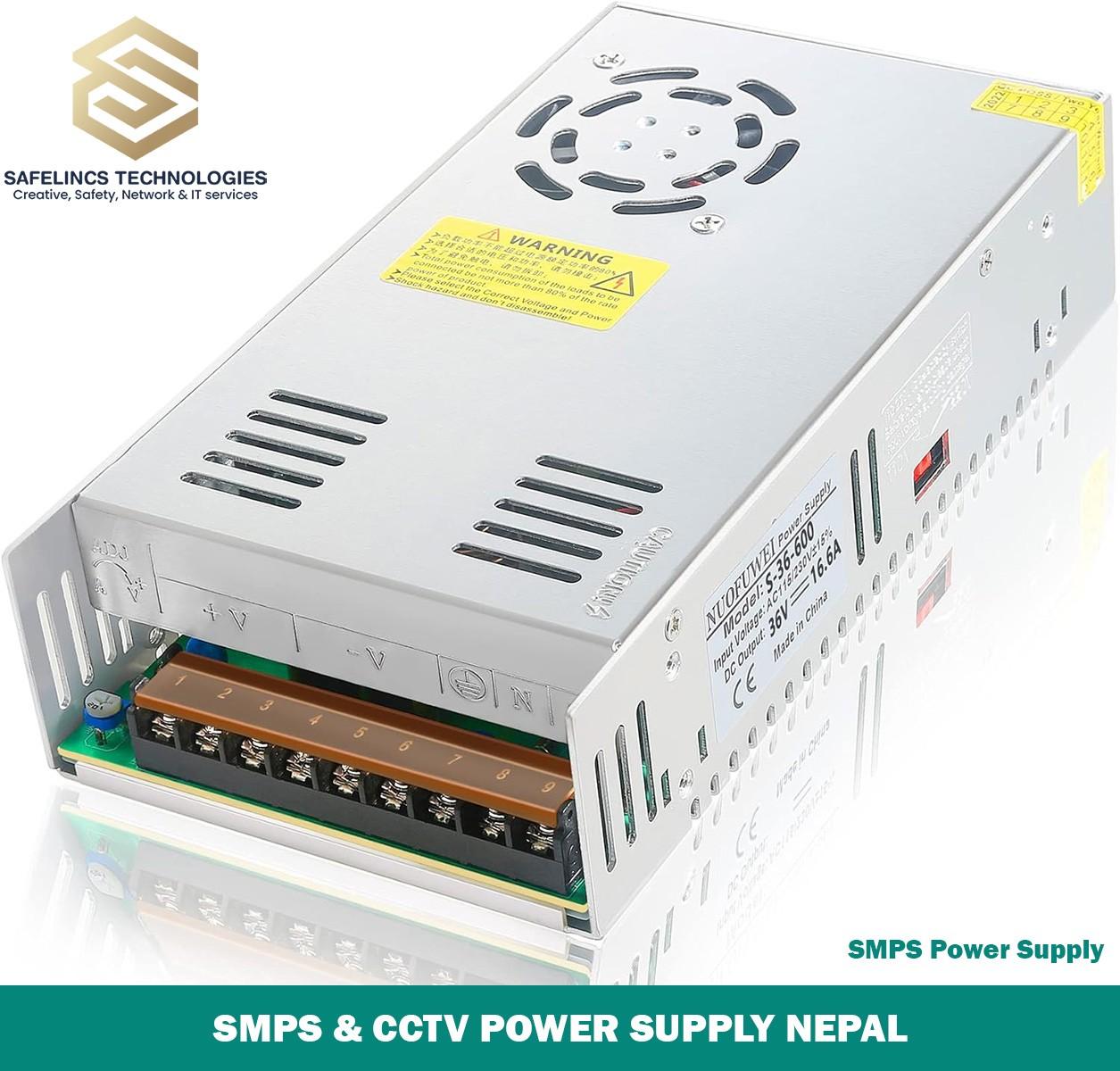
CCTV cameras require a stable power source that matches the manufacturer's specified input voltage, current demand and polarity. Many non-PoE surveillance cameras operate from a DC supply, while larger analog CCTV installations may use a centralized switched-mode power supply (SMPS) to distribute power to multiple camera points.
2. CCTV Voltage and Current Requirements
The power supply should not be selected only by voltage. Its available current must also accommodate the total connected camera load.
For multiple cameras: Minimum PSU Current ≈ Sum of Camera Current Requirements + Design Margin
For example, if several cameras share one centralized supply, the combined maximum load of those cameras should remain below the rated output capacity of the PSU.
Installers should also consider voltage drop. Longer cable distances, smaller conductor cross-sections and higher camera current can increase voltage loss between the power supply and camera.
Safelincs currently lists a CCTV SMPS & Power Supply product at Rs. 2,500, although prices may change with inventory and market conditions. Explore CCTV Power Supply & Jacks.
3. Individual Power Adapter vs Centralized SMPS
Parameter | Individual Adapter | Centralized SMPS |
Camera power | Dedicated per camera | Multiple cameras from one supply |
Fault isolation | Simple | Requires circuit identification |
Installation scale | Small systems | Multi-camera systems |
Power management | Distributed | Centralized |
Cable voltage drop | Depends on local supply location | Important on long power runs |
Maintenance | Multiple adapters | Central service point |
Neither configuration is universally better; selection depends on camera count, installation architecture and cable distance.
Cat6 Network Cable for IP CCTV Systems
Cat6 Ethernet cable is a major component in IP camera and PoE CCTV installations.
A typical network surveillance connection is: IP Camera → Cat6 → PoE Switch / Network Switch → NVR
The cable carries encoded video packets from the camera to the network. With compatible PoE equipment, the same cable can simultaneously deliver camera power.
When selecting Cat6 cable for CCTV, installers should evaluate conductor material, cable length, termination quality, PoE requirements and network bandwidth.
Safelincs currently has a dedicated Cat6 Network Cable category and lists a CCA Cat6 UTP network cable at Rs. 9,500 at the time of review.
1. Pure Copper vs CCA Cat6 Cable
Technical Factor | Pure Copper | Copper-Clad Aluminium (CCA) |
Electrical resistance | Lower | Higher |
Voltage drop | Lower | Higher |
PoE performance | Generally better | More distance/load sensitive |
Mechanical conductivity | Better | Lower |
Long cable runs | Preferred | Requires greater consideration |
Cost | Higher | Usually lower |
For PoE surveillance, conductor resistance is particularly important because the Ethernet cable is carrying electrical power as well as network data.
2. Cable Distance and Transmission Reliability
Cable performance can be affected by:
camera bitrate → cable quality → cable length → termination → network switch → recorder bandwidth
Poor RJ45 termination, damaged twisted pairs or low-quality conductor material can create packet loss, unstable PoE delivery or intermittent camera connectivity.
Surveillance Hard Drives and CCTV Storage
Video surveillance creates a continuous storage workload. A recorder may need to write multiple camera streams simultaneously for many hours or days without interruption.
A surveillance HDD is designed around workloads associated with continuous video recording and multiple incoming camera streams. This makes storage selection particularly important in DVR and NVR installations.
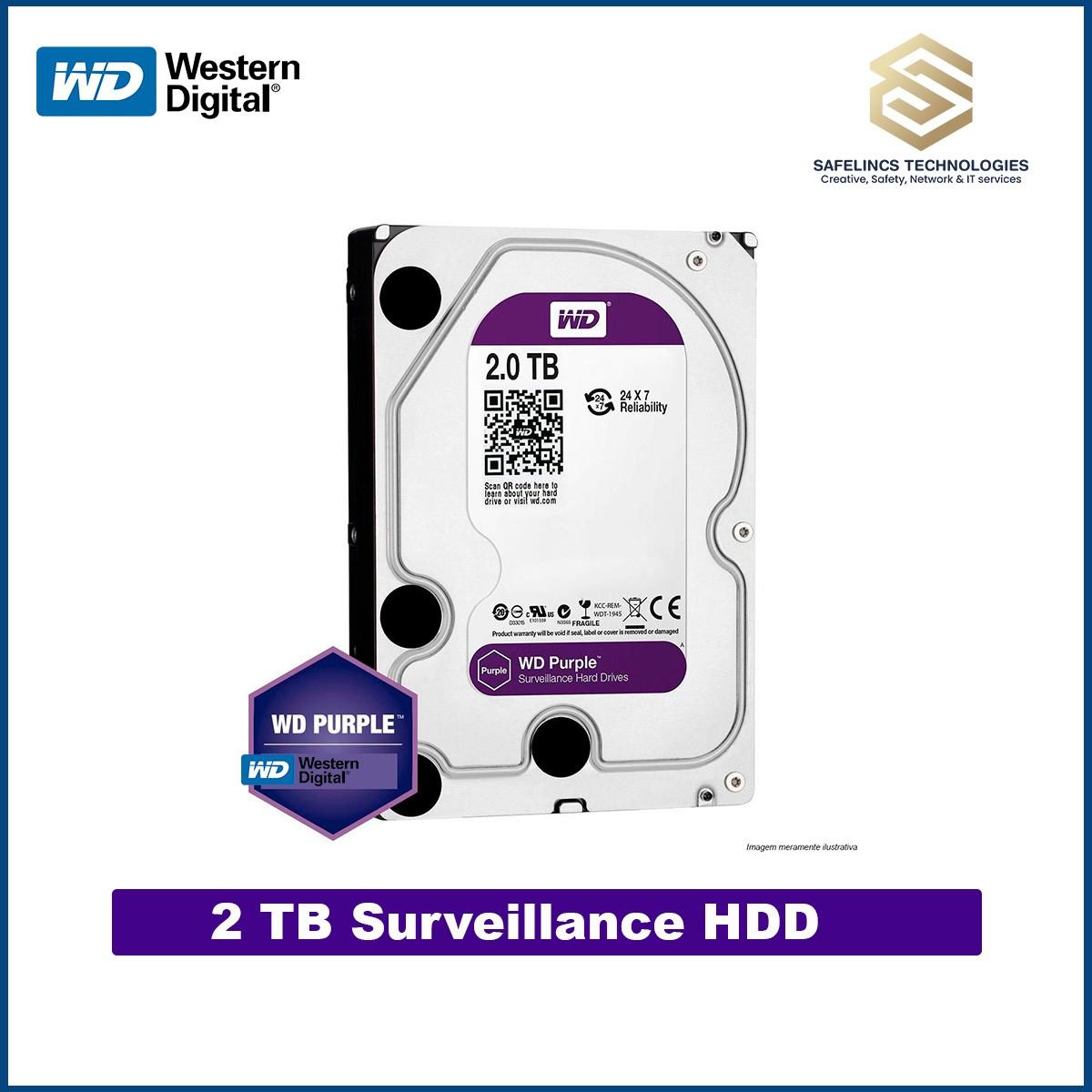
Safelincs currently lists the 2TB WD Purple Surveillance Hard Disk at Rs. 12,560 on the CCTV accessories page. Its dedicated HDD category also lists surveillance storage options and indicative capacities/pricing. Explore CCTV Hard Disk Drives & SSD.
Surveillance HDD vs SSD
Parameter | Surveillance HDD | SSD |
Storage technology | Magnetic disk | NAND flash |
Moving parts | Yes | No |
Cost per TB | Generally lower | Generally higher |
Large-capacity recording | Cost-effective | More expensive |
Typical CCTV role | Long-term video recording | Specialized/high-performance storage |
Key specification | Surveillance workload capability | Write endurance |
An SSD should not automatically be considered better simply because it is faster. CCTV recording is heavily dependent on capacity, sustained write workload, retention period and endurance, not only storage speed.
CCTV Storage Capacity Calculation
Storage requirements should be calculated before choosing the HDD.
The major parameters are:
Camera Count × Camera Bitrate × Recording Time × Retention Period
An approximate calculation is:
Storage (GB) ≈ Bitrate (Mbps) × 3600 × Recording Hours × Number of Cameras ÷ 8 ÷ 1000
For multi-day storage, multiply the result by the required number of recording days.
Actual storage consumption varies according to:
Parameter | Effect on Storage |
Resolution | Higher resolution generally increases data |
Frame rate | More frames can require more storage |
Codec | H.265 can reduce storage requirements versus less efficient encoding in many scenarios |
Bitrate | Higher bitrate directly increases data volume |
Camera count | More cameras require more storage |
Recording mode | Continuous recording typically uses more storage than event-based recording |
Retention period | More days require greater HDD capacity |
Therefore, simply purchasing “1TB” or “2TB” storage without calculating camera bitrate and retention requirements can result in insufficient recording history.
CCTV Connectors and Termination Components
Connections between CCTV devices must match the transmission technology being used.
1. BNC Connectors
BNC connectors are primarily associated with coaxial-based analog CCTV systems. They provide the physical video connection between camera cabling and equipment such as a DVR.
Improper termination can lead to poor contact, unstable signal transmission or intermittent video.
2. RJ45 Connectors
RJ45 connectors terminate twisted-pair Ethernet cable for: IP cameras → switches → PoE switches → NVRs → network infrastructure
Correct conductor termination and pair integrity are particularly important because IP CCTV systems transmit digital network traffic, and PoE installations may also carry electrical power over the same connection.
3. DC Power Connectors
DC connectors provide the electrical interface between a compatible power source and CCTV camera.
Installers should verify: connector dimensions + polarity + voltage + available current
before connecting power to the device.
Analog vs IP vs PoE CCTV Accessories
The required accessories vary considerably by surveillance architecture.
Component | Analog CCTV | IP CCTV | PoE IP CCTV |
Video/Data Cable | Coaxial or UTP + balun | Cat5e/Cat6 | Cat5e/Cat6 |
Typical Connector | BNC | RJ45 | RJ45 |
Camera Power | Separate DC supply | DC or PoE | PoE |
Recorder | DVR | NVR | NVR |
Surveillance HDD | Yes | Yes | Yes |
Network Switch | Usually not required | Often required | PoE switch commonly used |
Separate Camera Power Cable | Usually yes | Depends on design | Usually no |
Video Balun | May be used | Not normally required | Not normally required |
Safelincs provides separate categories for CCTV Surveillance Cameras & Systems, Network Video Recorders and CCTV & Network PoE Switches, allowing these components to be selected independently according to the surveillance architecture.
How to Select Compatible CCTV Accessories?
Accessory selection should follow the technical specification of the surveillance system rather than simply matching the brand name. Check the camera technology (analog/IP), operating voltage and maximum current, PoE capability and standard, transmission distance, cable conductor type, connector/interface, network bitrate, DVR/NVR channel and bandwidth capability, HDD interface and supported capacity, required recording retention, and future expansion capacity.
For example, increasing camera resolution without checking NVR incoming bandwidth and HDD capacity can create recording or retention limitations. Similarly, deploying PoE cameras requires consideration of not only switch port count but also the switch's total PoE power budget and per-port output.
CCTV Accessories Price in Nepal
The CCTV accessories price in Nepal varies according to specification, capacity, material, brand and installation requirement rather than accessory type alone.
Accessory | Main Price Factors |
CCTV Power Supply / SMPS | Voltage, output current, number of channels, protection |
Cat6 Cable | Cable length, conductor material, specification and brand |
Surveillance HDD | Capacity, workload design and drive series |
SSD | Capacity, interface and write endurance |
Connectors | Connector type, construction and quantity |
Installation Components | Material, mounting requirement and application |
Current examples on Safelincs include a CCTV SMPS & Power Supply at Rs. 2,500, CCA Cat6 UTP Network Cable at Rs. 9,500 and 2TB WD Purple Surveillance HDD at Rs. 12,560. These are current listed values and should be treated as indicative because online prices can change.
For larger systems, accessory selection should ideally be made after calculating the camera load, network architecture and recording-storage requirement.
CCTV Accessories for Reliable Surveillance Installation
A CCTV system should be engineered as one complete signal and power chain:
Stable Power → Correct Transmission Medium → Reliable Network/Signal Connection → Compatible Recorder → Sufficient Surveillance Storage
High-resolution cameras alone cannot guarantee reliable monitoring if supporting components introduce voltage drop, network bottlenecks, unstable connections or inadequate storage.
Safelincs Technologies provides CCTV cameras and supporting components for home, office and commercial surveillance installations in Nepal, allowing cameras, NVRs, PoE switches, Cat6 cables, surveillance storage and power accessories to be selected according to system requirements.
Frequently Asked Questions
1. What accessories are required for CCTV camera installation?
Analog CCTV commonly requires video cabling, BNC connections, DC power and a DVR, while IP systems normally use Ethernet cable, RJ45 connectivity, network equipment and an NVR. Both systems generally require surveillance storage for recorded footage.
2. What power supply is required for a CCTV camera?
The power supply voltage, polarity and available current must match the camera manufacturer's specification. For multiple cameras, calculate the combined maximum load before selecting a centralized PSU or SMPS.
3. Cat6 cable suitable for CCTV cameras?
Yes. Cat6 is commonly used for IP CCTV networks and can carry Ethernet data as well as PoE power when used with compatible devices.
4. Can a normal hard drive be used for CCTV recording?
A recorder may technically support different compatible drives, but surveillance HDDs are designed for sustained multi-stream recording workloads. Always check the DVR/NVR manufacturer's storage compatibility and maximum supported capacity.
5. How much storage does a CCTV system need?
Storage depends primarily on the number of cameras, bitrate, resolution, frame rate, codec, recording hours and required retention period. A storage calculation should therefore be performed before selecting HDD capacity.
6. What is the difference between BNC and RJ45 in CCTV?
BNC is typically used for coaxial connections in analog CCTV systems. RJ45 is used for Ethernet connectivity in IP camera networks.
7. What is the difference between CCTV SMPS and PoE?
An SMPS supplies electrical power to cameras through a dedicated power circuit. PoE-compatible networking can transmit both Ethernet data and electrical power over the same network cable.