
Fire Extinguisher Requirements for Warehouses: Types, Quantity & Placement Guide
Explore fire extinguisher requirements for warehouses in Nepal, including suitable types, quantity, placement, and fire safety considerations for storage areas, loading bays, electrical equipment, and forklift charging stations.
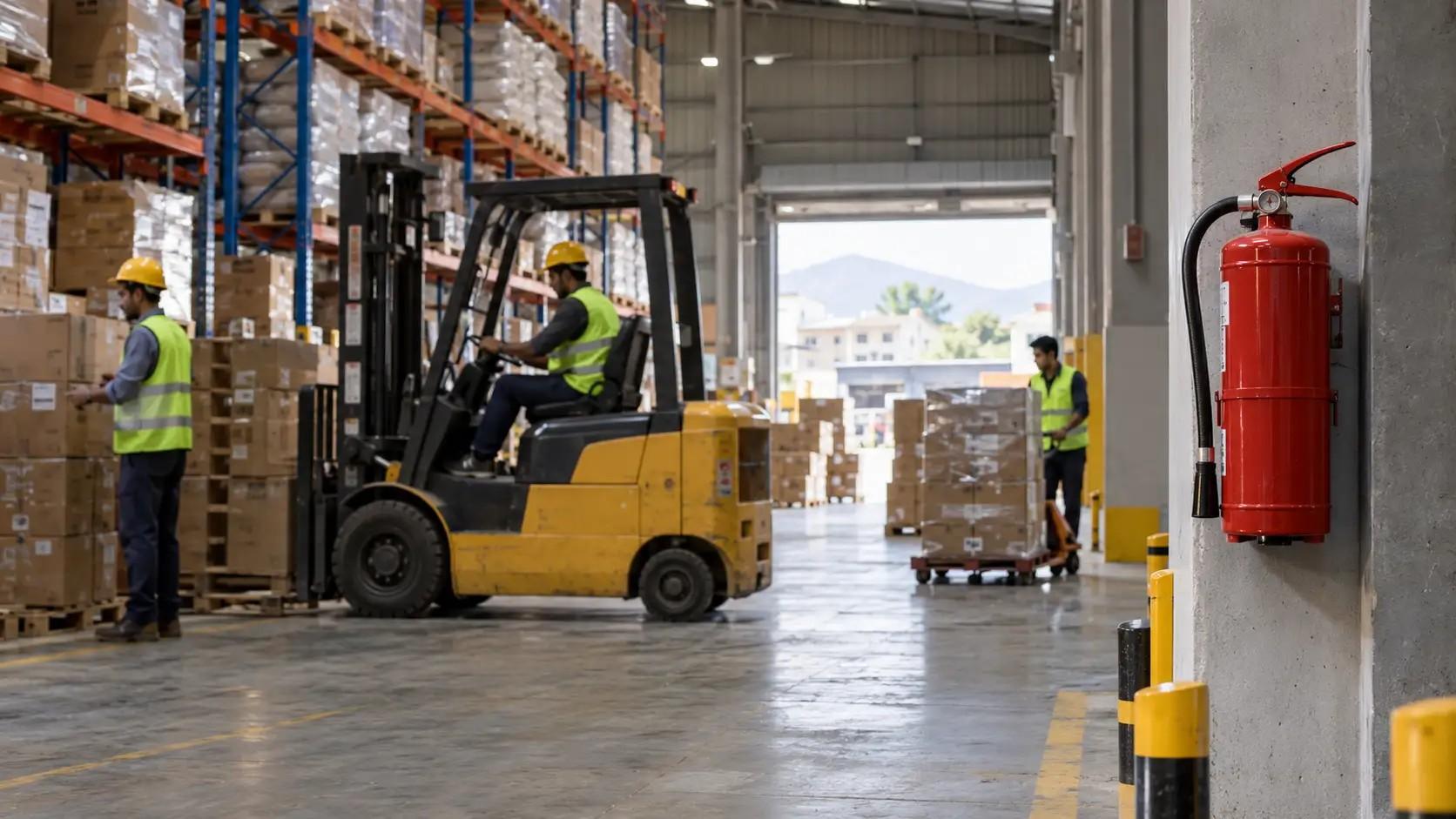
Warehouses present different fire risks from offices, schools and ordinary retail spaces. A warehouse can contain large quantities of combustible stock, cardboard packaging, plastic wrapping, wooden pallets, tall storage racks, electrical equipment, forklifts, battery-charging stations and, in some facilities, flammable liquids or chemicals.
Because of this concentrated fire load, selecting a fire extinguisher for a warehouse requires more than simply choosing the largest extinguisher available.
The correct fire-extinguisher plan should consider:
type of goods being stored
quantity and density of stored materials
packaging materials
rack height and layout
total warehouse floor area
number of floors or mezzanines
electrical equipment
flammable liquids or chemicals
forklift and battery-charging areas
loading and dispatch zones
extinguisher fire rating
access and travel distance
evacuation routes
Safelincs' current fire-extinguisher guidance also emphasizes that selection should consider fire class, extinguishing agent, fire rating, capacity, discharge characteristics and the installation environment, not cylinder size or price alone. For available options, explore fire extinguishers in Nepal.
Why Is Warehouse Fire Risk Different?
A warehouse can contain significantly more combustible material per square metre than many ordinary commercial spaces. A typical facility may combine:
Stored Goods + Packaging + Wooden Pallets + Plastic Wrapping + Racking + Electrical Equipment + Vehicles
Once a warehouse fire becomes established, flames can spread through nearby cartons, pallets, packaging and stored goods. High racks can also allow fire to spread vertically. The main concern is therefore not simply the size of the warehouse.
The type, amount and arrangement of combustible material are equally important. For example, a warehouse storing metal components may have a very different fire load from a facility containing: paper products, furniture, textiles, plastic goods, tyres, cardboard packaging or timber products.
This is why warehouse fire-extinguisher planning should begin with a hazard and stored-commodity assessment.
Identify the Materials Being Stored
Before choosing an extinguisher, identify what can actually burn.
Warehouse area/material | Typical fire concern | Main extinguisher consideration |
Paper and cardboard | Ordinary combustible fire | Suitable Class A protection |
Wooden pallets | High combustible loading | General combustible protection |
Textiles | Rapid fire spread | Class A protection |
Plastic products | Heat, smoke and combustible loading | Product-specific assessment |
Flammable liquids | Liquid fire | Appropriate Class B-rated protection |
Electrical panels | Energized equipment | Electrically suitable protection |
Machinery | Electrical, oil or mechanical hazards | Hazard-specific protection |
Battery charging | Electrical/battery risk | Dedicated assessment |
Loading bay | Vehicles, stock and packaging | Mixed-hazard protection |
Office/control room | Paper and electronics | General + electrical protection |
A warehouse storing packaged food, should not automatically receive the same extinguisher specification as a warehouse containing paint, solvents or industrial chemicals.
Common Warehouse Fire Hazards
A useful fire-risk assessment identifies both: Potential Fuel + Potential Ignition Source
1. Common Combustible Materials
Warehouse fuels can include: cardboard cartons, paper, wooden pallets, plastic packaging, fabrics, stored merchandise, lubricants, paints, solvents, cleaning materials and combustible waste.
2. Common Ignition Sources
Possible ignition sources include: faulty wiring, overloaded circuits, electrical panels, overheating machinery, forklift equipment, battery chargers, welding, cutting or hot work, heaters, vehicle engines and smoking. The relationship between the two is important.
For example, allowing cardboard packaging to accumulate around electrical equipment or charging stations increases the likelihood that a small equipment fault could develop into a larger warehouse fire.
Which Type of Fire Extinguisher Does a Warehouse Need?
There is no single extinguisher type suitable for every warehouse. The correct combination depends on the stored materials and identified fire hazards.
For many facilities, the main options include: ABC dry powder extinguishers, foam extinguishers and CO₂ extinguishers. Specialist warehouses may require additional fire-protection solutions.
1. ABC Fire Extinguishers for Warehouses
ABC dry-powder extinguishers are commonly selected where several general fire hazards may be present.
Depending on their individual fire rating, they may be suitable for warehouse areas containing materials such as: paper, cardboard, wood, packaging, textiles and certain other mixed hazards.
Safelincs currently supplies multiple sizes of ABC fire extinguishers, including products intended for commercial and industrial environments. The company's current 9 kg Cease Fire ABC unit, lists separate fire ratings and technical specifications rather than relying on the 9 kg capacity alone.
This illustrates an important warehouse-safety principle: Extinguisher capacity and extinguisher fire rating are not the same thing.
A larger cylinder should not automatically be assumed to provide the most appropriate protection for a particular hazard.
Where ABC Extinguishers May Be Considered
Depending on the risk assessment:
general storage areas
dispatch areas
packaging areas
pallet storage
loading zones
mixed commercial/industrial areas
However, ABC powder leaves residue after discharge, so it may not be the preferred solution around sensitive electronic equipment.
2. Foam Fire Extinguishers for Warehouses
Foam extinguishers may be appropriate for certain warehouses containing suitable combustible materials and flammable-liquid hazards. Safelinc’s current AFFF foam fire extinguisher range is marketed for commercial and industrial environments.
Depending on the product rating, foam can be considered for risks involving materials such as: wood, paper, fabrics and appropriate flammable liquids.
Foam should not automatically be used throughout an entire warehouse simply because some flammable liquids are present. The selected extinguisher must match the specific hazard and manufacturer instructions, particularly where energized electrical equipment is nearby.
3. CO₂ Fire Extinguishers for Warehouse Electrical Equipment
Warehouses frequently contain electrical systems including: distribution boards, control panels, industrial machinery, conveyors, computers, CCTV equipment, UPS systems, network equipment and electrical charging systems.
For appropriate electrical hazards, a CO₂ fire extinguisher may be considered. CO₂ has an additional advantage around electrical and electronic equipment because it leaves no powder residue after discharge.
Safelincs currently identifies CO₂ extinguishers for electrical and appropriate flammable-liquid applications and specifically lists warehouses among the locations in which they may be used.
CO₂ should not, however, be treated as the main extinguisher for large quantities of cardboard, timber or other deep-seated ordinary combustibles.
ABC vs Foam vs CO₂ for Warehouse Applications
The extinguisher type should match the hazard.
Requirement | ABC Dry Powder | Foam | CO₂ |
Paper/cardboard | Often suitable when rated | Often suitable when rated | Not normally primary protection |
Wood/pallets | Common application | Common application | Not normally primary protection |
Mixed warehouse hazards | Broad application | More hazard-specific | Specialist role |
Flammable liquids | Depending on rating | Common application | Depending on rating |
Electrical equipment | Check product specification | Generally not selected for energized equipment unless specifically approved | Common application |
Sensitive electronics | Powder residue can be problematic | Not generally preferred | No solid residue |
Cleanup after discharge | Significant | Foam/liquid cleanup | Minimal solid residue |
Always check the individual extinguisher's:
fire classification
extinguishing agent
tested rating
manufacturer limitations
operating instructions
Safelincs' PASS-method guidance makes the same point: equipment should be selected according to the actual fire hazard rather than simply its colour, size or location.
Warehouse Fire Load and Stored Commodities
Fire load is a particularly important consideration in warehouse protection. In practical terms, it relates to the amount of combustible material available to contribute energy to a fire.
Compare:
Warehouse A: Metal machinery components with minimal packaging.
Warehouse B: Floor-to-ceiling racks containing cardboard boxes, plastic packaging and textile products.
Even if both warehouses have identical dimensions, their fire behaviour and protection requirements may be substantially different.
Warehouse fire-risk assessment should, therefore consider:
material type
quantity
packaging
storage height
storage density
rack arrangement
how rapidly fire could spread between goods
This is one reason extinguisher quantity should not be calculated from floor area alone.
Why Rack Height and Layout Matter?
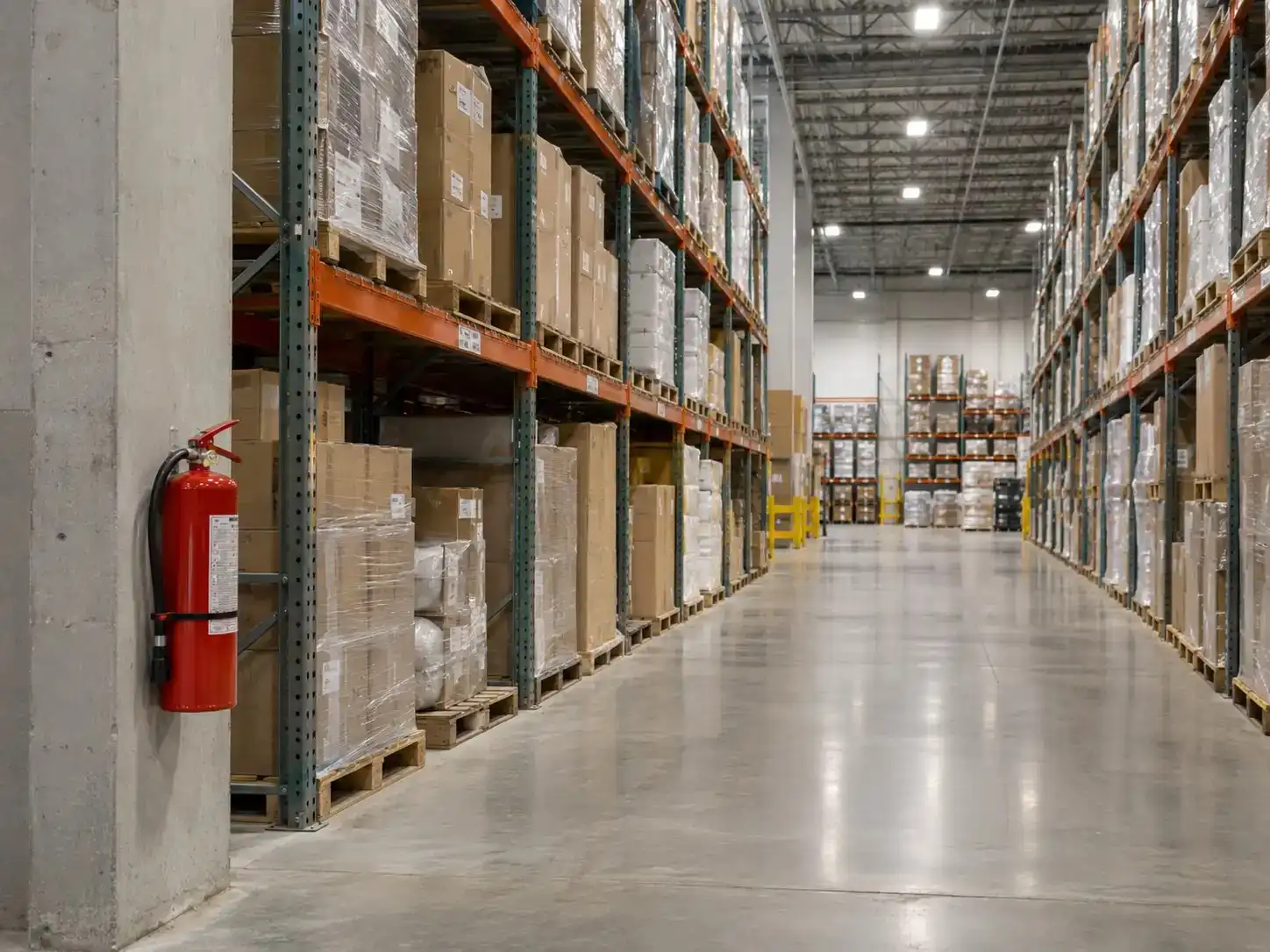
Warehouse racking affects both fire development and extinguisher accessibility. Consider a large storage facility containing rows of tall racks. An extinguisher may appear close to a worker when measured in a straight line, but the worker may actually have to travel to the end of an aisle and around several racks to reach it.
Important factors include:
rack height
aisle length
aisle width
dead-end aisles
cross aisles
stock protruding into pathways
temporary pallet storage
changing warehouse configurations
Extinguishers should not become hidden behind: racks, stacked cartons, pallets, parked forklift or temporary goods. Placement should therefore consider actual travel routes, not only visual distance on a floor plan.
Flammable-Liquid Storage Areas
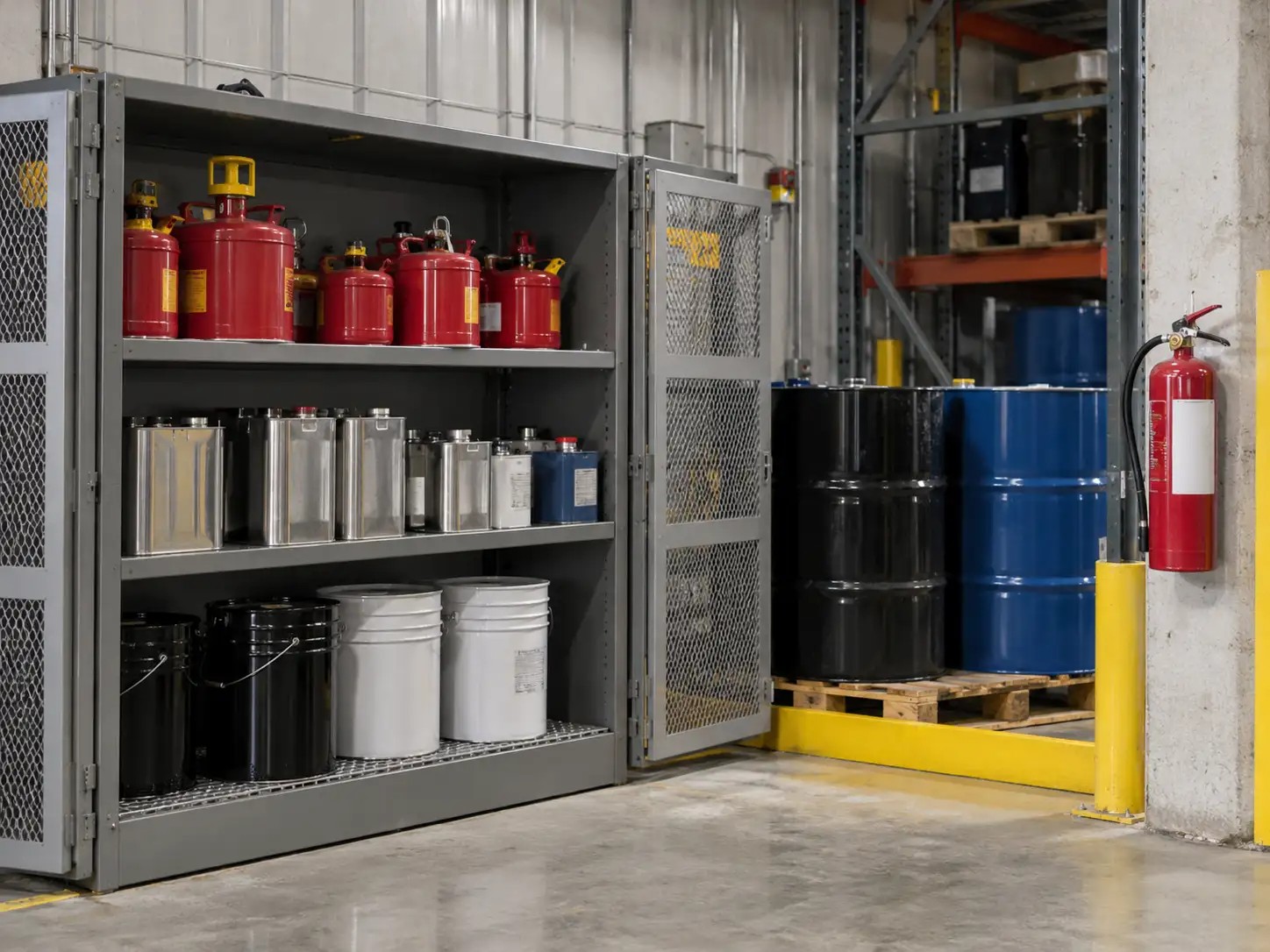
Warehouses containing flammable liquids require separate assessment. Examples can include: petrol, diesel, solvents, paints, thinners, lubricants and cleaning chemicals. These areas should not simply depend on the same extinguisher arrangement used for cardboard storage.
Depending on the individual material and extinguisher rating, suitable protection may involve ABC, foam, CO₂ or another specialist system.
The Safety Data Sheet (SDS) for stored chemicals should also be reviewed because it can provide important information about:
fire hazards
incompatible materials
firefighting measures
suitable or unsuitable extinguishing media
Chemical and Specialist Warehouses
Warehouses containing industrial chemicals require additional caution. Not every extinguishing agent is compatible with every substance. For specialist chemical storage, extinguisher selection should consider:
chemical properties
SDS firefighting recommendations
storage quantities
segregation requirements
potential reactions
applicable regulations
professional fire-risk assessment
The extinguisher used for ordinary cardboard cartons should therefore never automatically be assumed suitable for a specialist chemical incident.
How Many Fire Extinguishers Does a Warehouse Need?
There is no universal extinguisher quantity that applies to every warehouse. A statement such as “one extinguisher for every X square metres” can be misleading unless the applicable standard, extinguisher rating, travel distance and hazard classification are also considered.
Instead, quantity should be based on several factors, which are as follows:
1. Total Floor Area
A larger facility generally needs more distributed fire-extinguisher coverage. However, area is only one part of the calculation.
2. Type of Material Stored
Combustible stock, flammable liquids and specialist materials may create different extinguisher requirements.
3. Fire Load
Large quantities of densely stored combustible materials can significantly increase fire severity.
4. Extinguisher Fire Rating
Two cylinders of similar physical size can provide different firefighting performance. Safelincs' current fire-safety information, for example, lists a 9 kg ABC unit with a published 43A/233B rating, illustrating why fire rating should be considered alongside capacity.
5. Travel Distance
Staff should be able to reach a suitable extinguisher quickly without travelling through the developing fire. Warehouse racking can make travel distance particularly important.
6. High-Risk Areas
Additional dedicated protection may be necessary around: electrical rooms, plant rooms, flammable-liquid storage, battery-charging stations, workshops, loading bays, generators and control rooms.
7. Floors and Mezzanines
A warehouse with mezzanine storage should assess each level separately. Extinguishers located only at ground level should not automatically be assumed to provide adequate protection for an upper storage level.
8. Building Configuration
Separate storage halls, long aisles, partitions and restricted-access zones may require additional extinguisher locations.
A Better Way to Calculate Warehouse Requirements
Rather than starting with a predetermined number, use:
Stored Material → Fire Load → Hazard Zones → Fire Classes → Extinguisher Type → Fire Rating → Floor Coverage → Travel Distance → Specialist Hazards → Quantity → Placement
This provides a more defensible fire-safety plan than simply placing identical extinguishers at equal visual intervals.
Fire Extinguisher Placement in Warehouses
Correct placement is particularly important because warehouse stock constantly moves. Safelinc’s current guidance states that extinguishers should remain visible, unobstructed and accessible, and their placement should account for the identified hazard and safe access.
Depending on the fire-risk assessment, suitable areas to consider may include:
main circulation aisles
escape routes
appropriate exit areas
loading bays
packing sections
electrical-room entrances
workshop areas
charging zones
control rooms
identified higher-risk areas
Do Not Place Extinguishers Where They Can Be:
hidden by stock
blocked by pallets
obstructed by forklifts
concealed behind racks
damaged by warehouse vehicles
inaccessible after layout changes
trapped behind the likely location of a fire
Extinguisher positions should be reviewed whenever racking or operational layouts change.
Loading Bay Fire Risks
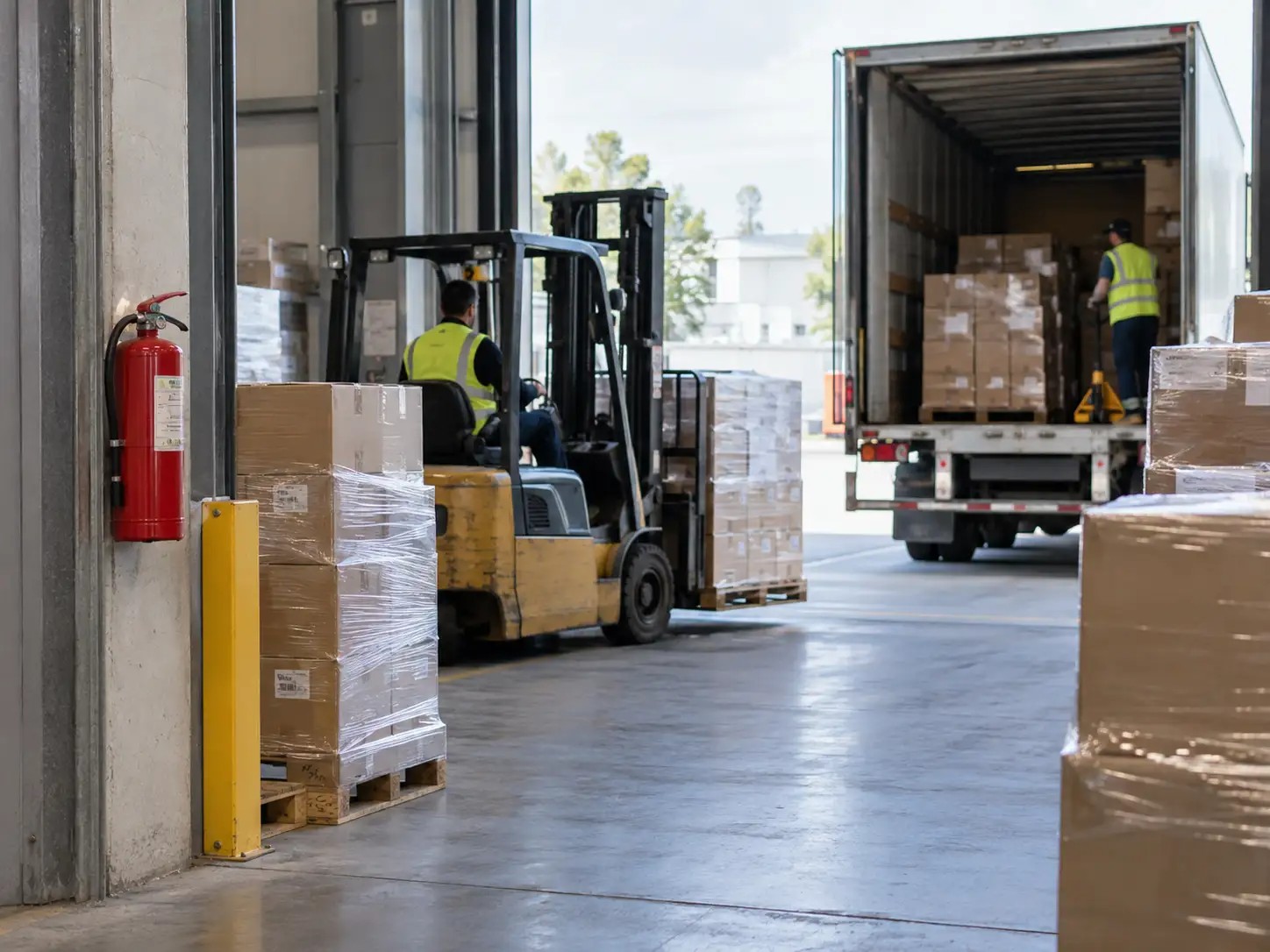
Loading bays combine several hazards in one area. These can include:
Vehicles + Fuel + Pallets + Cardboard + Electrical Equipment + Temporary Stock
Common concerns include: trucks and delivery vehicles, forklifts, packaging waste, temporary pallet accumulation, vehicle electrical systems and fuel or oil. Loading areas should therefore be treated as separate hazard zones rather than assuming the nearest storage-area extinguisher automatically provides sufficient protection.
Good housekeeping is especially important. Packaging waste and combustible materials should not be allowed to accumulate around vehicle routes or electrical equipment.
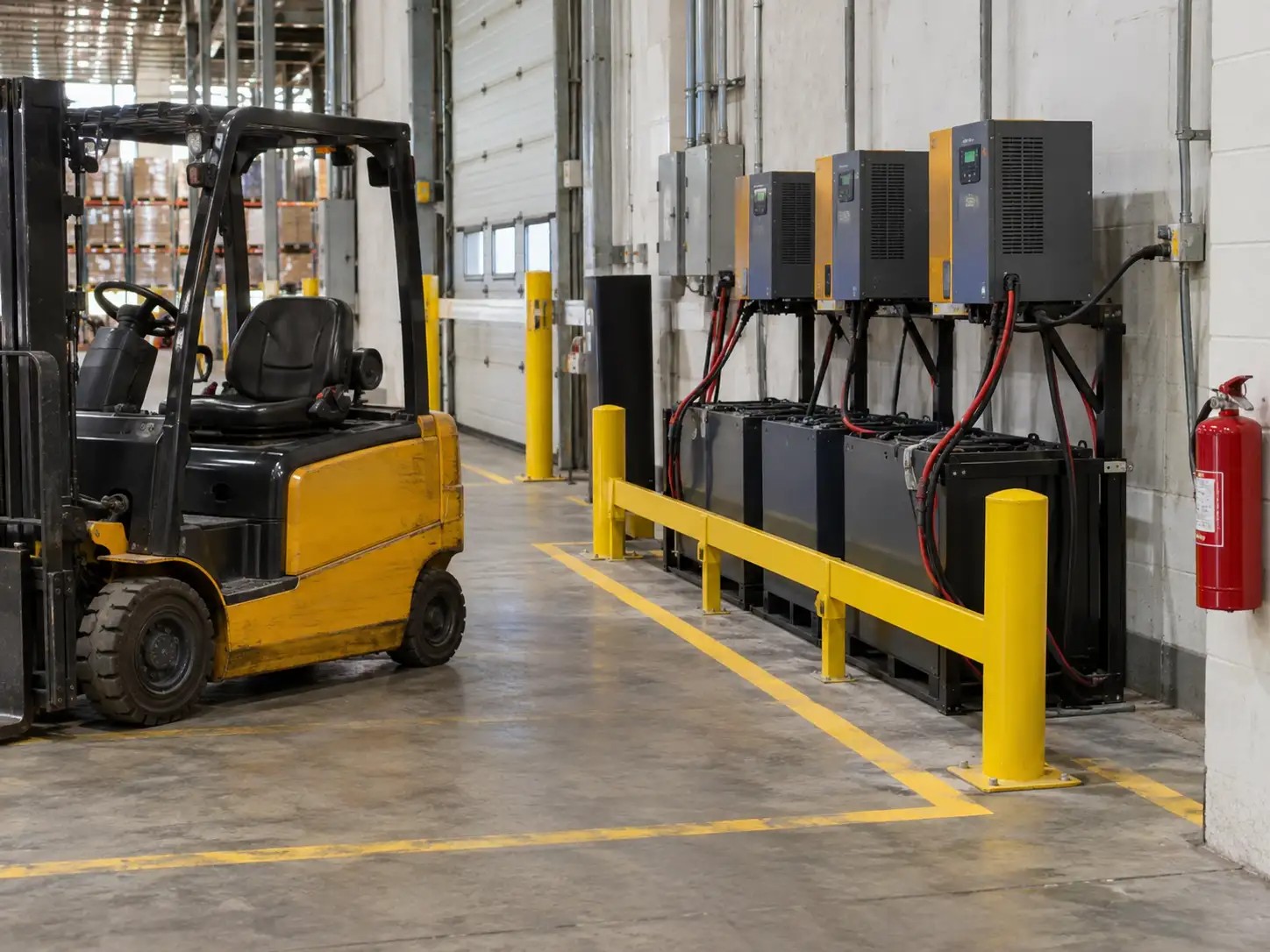
Forklift and Battery-Charging Areas
Forklift charging areas can introduce electrical and battery-related risks. The exact hazard depends partly on the type of battery technology used. A charging area should be assessed for:
charging equipment
electrical connections
damaged cables
ventilation requirements
overheating
nearby combustible materials
emergency isolation
Battery-charging stations should not be surrounded by cardboard, wooden pallets or other unnecessary combustible materials. Where significant or specialist battery systems are used, the fire response should be evaluated separately rather than assuming the ordinary warehouse extinguisher is sufficient.
Electrical and Control Rooms
Electrical areas may contain:
distribution boards
switchgear
automation equipment
motor controls
network equipment
UPS systems
CCTV/control systems
CO₂ or another appropriately rated solution may be considered depending on the equipment and fire-risk assessment. The extinguisher should be positioned so that personnel do not have to move toward the equipment fire to retrieve it.
Electrical rooms should also not be used as general storage areas for cartons or warehouse supplies.
Warehouse Offices and Control Rooms
Many warehouses include internal administrative offices or security/control rooms. These introduce a combination of: paper, furniture, computers, CCTV equipment, networking hardware and electrical appliances.
These areas should be assessed separately from the main warehouse floor. Where sensitive electronics are present, the residue produced by a dry-powder extinguisher may also influence the choice of supplementary protection.
Portable Extinguishers Are Only One Part of Warehouse Fire Safety
Large warehouses should not depend entirely on portable extinguishers. Fire extinguishers are intended primarily as first-response equipment for small, developing fires. Depending on warehouse size, layout and risk, a wider fire-protection strategy may include:
smoke detection
heat detection
beam detectors
manual call points
fire-alarm panels
audible/visual alarms
fire hydrants
hose reels
sprinklers
emergency lighting
emergency exits
fire-resistant compartmentation
portable extinguishers
Safelincs' broader fire safety equipment range covers detection, firefighting and emergency-safety products, while its current technical guidance also highlights the need to consider rating, pressure, discharge characteristics and overall system engineering rather than evaluating individual equipment in isolation.
Warehouse Fire Extinguisher Inspection and Maintenance
Warehouse environments can be demanding for portable extinguishers. Equipment may be exposed to: dust, impact, vibration, moving vehicles, moisture, heat and changing stock configurations.
Routine checks should confirm that:
the extinguisher remains in its assigned location
access is clear
signage is visible
safety pin is intact
tamper seal is present
pressure gauge is in the correct operating range where fitted
hose and nozzle are undamaged
cylinder has no significant corrosion or physical damage
bracket or stand is secure
instructions remain readable
Any extinguisher that has been discharged even partially, should be inspected and properly serviced before being returned to operational use.
Warehouse Staff Fire-Safety Training
Appropriate warehouse staff should understand: extinguisher locations, alarm procedures, emergency exits, which extinguisher matches which hazard, when not to attempt firefighting, how to maintain an escape route and when evacuation must take priority.
For appropriate portable extinguishers, the basic operating method is commonly remembered as:
P: Pull the pin
A: Aim at the base of the fire
S: Squeeze the handle
S: Sweep across the base
For detailed instructions, see Safelinc’s How to Use a Fire Extinguisher: PASS Method Guide. The correct extinguisher must be identified before attempting to fight the fire.
Warehouse Fire Safety Checklist
Warehouse owners and facility managers can use this checklist:
Stored materials identified
Packaging materials assessed
Overall fire load evaluated
Rack height and layout considered
Aisle travel distances checked
Flammable liquids identified
Chemical storage reviewed separately
Electrical panels assessed
Machinery and plant areas evaluated
Forklift charging areas assessed
Battery technology identified
Loading bays reviewed
Workshops and hot-work areas assessed
Correct extinguisher types selected
Extinguisher fire ratings verified
Quantity based on risk, rating and layout
Extinguishers clearly visible
Pallets and stock do not block access
Escape routes remain clear
Fire-alarm/detection systems maintained
Hydrant or suppression systems inspected where installed
Staff know emergency procedures
Extinguisher inspections and servicing are documented
Choosing Fire Extinguishers for Your Warehouse in Nepal
The correct warehouse fire extinguisher should be selected from the actual risk rather than simply warehouse size.
Consider: Stored Commodity + Fire Load + Racking + Electrical Risk + Specialist Storage + Fire Rating + Travel Distance + Building Layout
Depending on the facility, protection may include:
ABC Dry Powder: For appropriate general combustible and mixed warehouse hazards.
Foam: For appropriate combustible-solid and flammable-liquid hazards.
CO₂: For suitable energized electrical and electronic equipment.
Specialist warehouses containing chemicals, unusual flammable materials or significant battery-storage systems may require additional engineering and dedicated fire-protection measures.
Safelincs Technologies supplies fire extinguishers in Nepal together with wider fire safety equipment for warehouses, industrial properties and logistics facilities. The final extinguisher type, rating, quantity and placement should be based on a site-specific assessment and the applicable fire-safety requirements rather than purchasing identical cylinders for every warehouse area.
Frequently Asked Questions
1. Which fire extinguisher is best for a warehouse?
There is no single extinguisher suitable for every warehouse. ABC extinguishers may suit many general risks, while foam, CO₂ or specialist protection may be required depending on stored materials and equipment.
2. How many fire extinguishers does a warehouse need?
The quantity depends on floor area, stored materials, fire load, extinguisher rating, rack configuration, travel distance and specialist hazard areas. The final number should therefore be determined from the actual warehouse layout and risk.
3. Is an ABC extinguisher suitable for a warehouse?
ABC extinguishers can be suitable for many general warehouse hazards when their fire rating matches the identified risk. Check the individual product rating rather than selecting solely by cylinder capacity.
4. Can foam extinguishers be used in warehouses?
Foam extinguishers may be suitable for appropriate combustible-solid and flammable-liquid hazards. Their use should be determined from the actual material involved and individual product specifications.
5. Which extinguisher is suitable near electrical panels?
CO₂ is commonly considered for appropriate energized electrical equipment because it leaves virtually no solid residue. The selected extinguisher should still match the equipment and identified fire hazard.
6. Where should fire extinguishers be placed in a warehouse?
Extinguishers should be visible, unobstructed and accessible along appropriate circulation or escape routes and near identified higher-risk zones. Racks, pallets or forklifts should not block access.
7. Does warehouse racking affect extinguisher placement?
Yes. Long or high storage racks can increase actual walking distance and obstruct visibility. Placement should therefore consider real access routes through the warehouse.
8. Do forklift battery-charging areas need separate protection?
Battery-charging areas should be assessed separately because they introduce concentrated electrical and battery-related hazards. The appropriate protection depends on the battery technology and surrounding conditions.
9. Are fire extinguishers enough for warehouse fire protection?
No. Large warehouses may also require detection, alarms, hydrants, sprinklers, emergency exits, emergency lighting and passive fire-protection measures depending on the facility.