
How to use a fire extinguisher?
Learn how to use a fire extinguisher safely and correctly with the PASS method. This technical guide explains extinguisher operation, fire-type selection, pressure checks, discharge technique, common mistakes, and key safety precautions for homes and businesses.
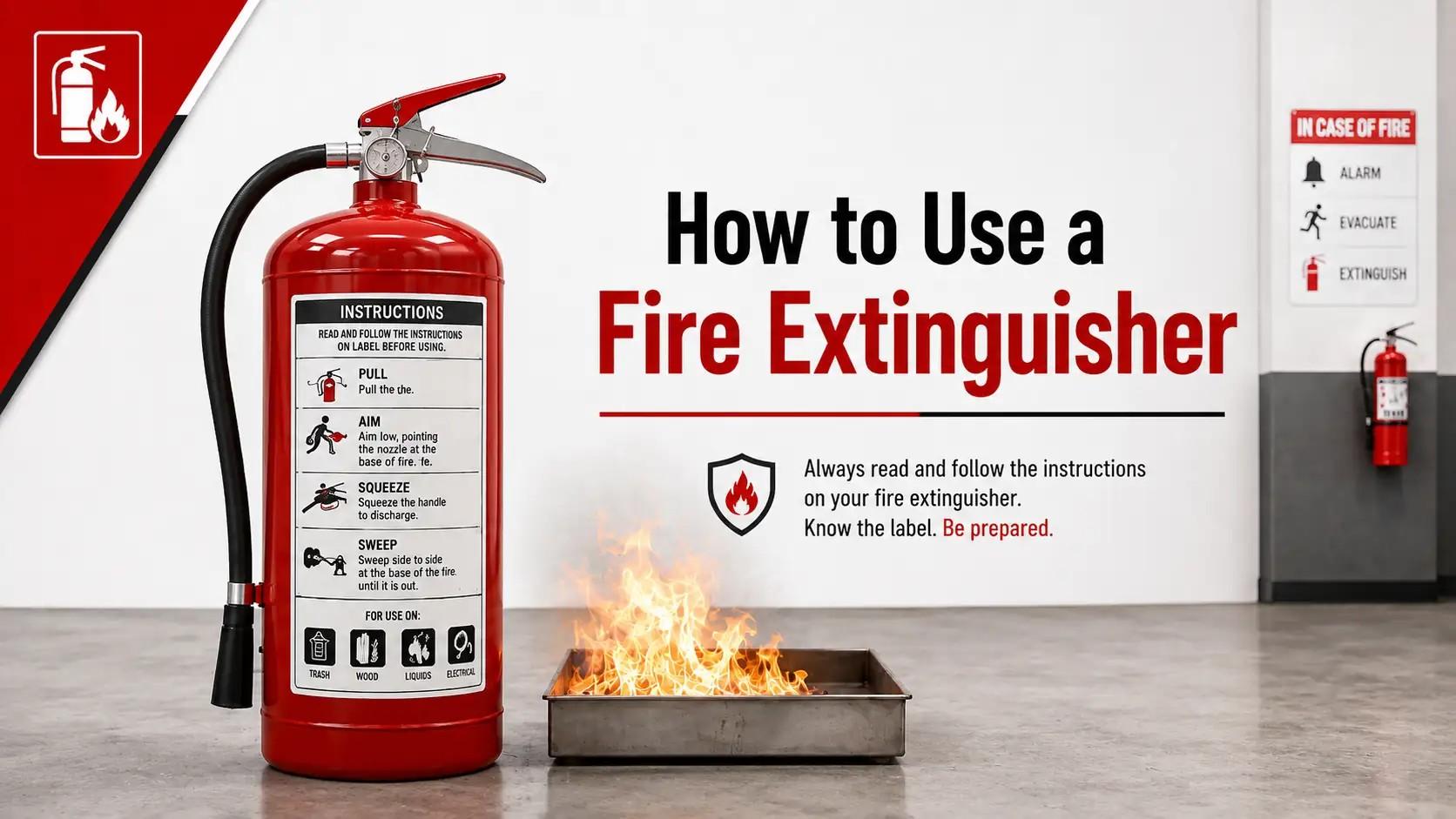
A portable fire extinguisher is a pressurized fire-suppression device designed to discharge a specific extinguishing agent onto a developing fire. Effective use depends on more than simply knowing the PASS method. The user must also identify the fire hazard, select the correct extinguisher, understand its operating characteristics and maintain a clear escape route.
Most portable extinguishers can be operated using the PASS method: Pull, Aim, Squeeze and Sweep. However, the PASS method should only be used after confirming that the extinguisher is suitable for the material involved and that the fire is still small enough to approach safely.
Before an emergency occurs, it is also important to have the correct fire safety products in Nepal installed according to the risks present in the building. Safelincs currently supplies extinguishers, detection devices, alarm equipment, hydrant components and other fire-protection products for residential, commercial and industrial applications.
How Does a Fire Extinguisher Work?
Fire depends on four basic elements:
Fuel + Heat + Oxygen + Chemical Chain Reaction
This is commonly described as the fire tetrahedron.
A fire extinguisher works by removing or interrupting one or more of these elements. Different extinguishing agents work in different ways.
Extinguishing Agent | Main Suppression Mechanism | Typical Application |
Water | Removes heat through cooling | Suitable combustible solids |
Foam | Cools and forms a barrier over the fuel surface | Suitable solid and flammable-liquid fires |
ABC dry chemical powder | Interrupts the chemical chain reaction and separates flame from fuel | Multipurpose applications |
CO₂ | Displaces oxygen around the flame and provides limited cooling | Electrical equipment and suitable flammable-liquid fires |
Wet chemical | Cools and reacts with hot cooking oils/fats | Commercial cooking environments |
This is why the correct extinguisher should be selected according to fire rating, extinguishing agent and application, rather than simply cylinder capacity.
Safelincs' fire extinguisher range in Nepal currently includes ABC dry powder, CO₂, foam and other extinguisher categories.
Before Using a Fire Extinguisher: Technical Pre-Use Check
Before operating an extinguisher, make several quick safety and equipment checks.
1. Identify the Fire Hazard
Determine what material is burning.
The extinguishing agent must be compatible with the fire. Using an unsuitable agent can reduce effectiveness and, in some cases, increase the hazard.
Check the extinguisher's:
Fire classification
Extinguishing agent
Application symbols
Operating instructions
Manufacturer limitations
Do not select an extinguisher based only on its colour, size or location.
2. Confirm the Extinguisher Is Ready for Operation
For stored-pressure extinguishers, visually inspect the pressure indicator where fitted.
The gauge generally indicates whether the extinguisher is:
Undercharged → Normal operating range → Overcharged
The exact acceptable range depends on the equipment.
The pressure gauge does not directly measure the quantity of extinguishing agent inside the cylinder. It indicates internal pressure.
Safelincs' ABC fire extinguishers include stored-pressure models fitted with a manometer. The company's ABC category notes that the gauge's green zone indicates the extinguisher is in its normal ready condition.
Also check that:
The safety pin is present
The tamper seal is intact
The hose or nozzle is not blocked
The cylinder shows no obvious major damage
The extinguisher is accessible
3. Check Your Escape Route
Before moving toward the fire, position yourself so that an exit remains behind you. Never allow the fire to move between you and the escape route.
If the fire expands rapidly, smoke reduces visibility, or the extinguisher cannot control the fire, evacuate instead of continuing the attempt.
How to Use a Fire Extinguisher Using the PASS Method
The standard operating sequence for many portable extinguishers is remembered using PASS:
Letter | Action | Technical Purpose |
P | Pull the pin | Releases the operating mechanism |
A | Aim at the base | Directs agent toward the fuel source |
S | Squeeze the lever | Opens the valve and starts discharge |
S | Sweep side to side | Distributes agent across the burning area |
Step 1: Pull the Safety Pin
Hold the extinguisher upright and locate the safety pin near the operating handle. Then, pull the pin completely out.
The pin is designed to prevent accidental activation of the valve or squeeze-grip mechanism. Removing it allows the operating lever to move.
Do not wait until you are extremely close to the fire before removing the pin.
Step 2: Aim at the Base of the Fire
Direct the hose, nozzle or discharge horn toward the base of the fire, not the upper flames. This is important because the extinguishing agent must act on the burning fuel or combustion zone.
Aiming only at visible flames may temporarily disturb the flame without properly suppressing the source. Maintain the operating distance specified on the extinguisher.
Step 3: Squeeze the Operating Lever
Firmly squeeze the operating handle. On a stored-pressure extinguisher, this opens the discharge valve and allows the internal pressure to force the extinguishing agent through the hose or nozzle.
Technical characteristics vary between models, including:
discharge duration
flow rate
discharge range
operating pressure
nozzle design
extinguishing-agent mass
For example, Safelincs lists its 9 KG Cease Fire ABC Fire Extinguisher with a squeeze-grip discharge mechanism, 15-bar working pressure and an approximately 7-metre throw.
This demonstrates why users should follow the specifications of the actual extinguisher being used rather than assuming every unit has the same range.
Step 4: Sweep From Side to Side
Once discharge begins, sweep the nozzle steadily from side to side across the base of the burning area. Do not make extremely rapid movements.
The objective is to distribute the extinguishing agent over the active combustion area.
Continue until:
visible flames are suppressed
the burning surface is adequately covered
conditions remain safe
After the fire appears extinguished, move backward toward your exit while continuing to monitor the area for reignition.
PASS Method Summary
P: Pull the pin
A: Aim at the base of the fire
S: Squeeze the operating handle
S: Sweep from side to side
This sequence should be learned before an emergency rather than read for the first time during a fire.
How to Use an ABC Fire Extinguisher ?
ABC dry chemical extinguishers are among the most common portable extinguishers because they can be used across several common fire hazards when appropriately rated.
Safelincs' ABC fire extinguisher range includes multiple stored-pressure capacities. The category describes units containing mono-ammonium phosphate-based dry chemical powder with nitrogen commonly used as the propellant.
Typical ABC extinguisher construction includes:
steel pressure cylinder
dry chemical extinguishing agent
pressurizing gas
valve assembly
safety pin
pressure gauge/manometer
discharge hose or nozzle
squeeze-grip operating lever
ABC Operating Procedure
Check that the fire rating is suitable.
Confirm the pressure gauge indicates normal condition.
Pull the safety pin.
Aim at the base of the fire.
Squeeze the handle.
Sweep across the fuel surface.
Dry chemical powder interrupts the chemical chain reaction occurring in the flame zone.
One technical disadvantage is the residue left after discharge. For this reason, ABC powder may not always be the preferred first choice around highly sensitive electronics even where the extinguisher is technically rated for the hazard.
How to Use a CO₂ Fire Extinguisher ?
A CO₂ extinguisher contains carbon dioxide stored under pressure. Unlike ABC powder, CO₂ leaves virtually no solid extinguishing residue, which makes it useful around suitable electrical and electronic equipment.
Safelincs' CO₂ fire extinguisher range includes portable models for appropriate electrical and flammable-liquid hazards.
How CO₂ Suppression Works
When released, liquid/pressurized CO₂ rapidly expands into gas. Its primary extinguishing effect is to reduce the oxygen concentration immediately surrounding the combustion zone. Expansion also produces a significant cooling effect at the discharge assembly.
CO₂ Operating Procedure
Remove the safety pin or locking device.
Hold only the designated insulated handling area.
Direct the horn toward the base of the fire.
Operate the lever.
Sweep the discharge across the affected area.
Important CO₂ Safety Consideration
The discharge horn and associated components can become extremely cold during operation. Do not hold an uninsulated section of the horn unless the extinguisher manufacturer specifically identifies it as a handling point.
CO₂ is also an asphyxiation hazard at high concentrations, particularly in confined spaces, so ventilation and evacuation conditions must be considered.
How to Use a Foam Fire Extinguisher
Foam extinguishers work differently from powder and CO₂ systems. Foam can provide two main extinguishing effects:
Cooling + Fuel-surface separation
The foam blanket can reduce vapour release and limit contact between oxygen and the burning fuel surface. Safelincs provides foam fire extinguishers for suitable fire applications.
For example, the current Safelincs Fire Safety page lists a 9-litre AFFF foam extinguisher with approximately 15-bar working pressure, 35-bar hydrostatic test pressure and a 6-metre discharge throw.
Always follow the specific application instructions of the foam extinguisher being used.
Understanding Fire Extinguisher Working Pressure
Working pressure is the internal pressure at which the extinguisher is designed to operate under normal conditions. It should not be confused with hydrostatic test pressure.
For example, Safelincs lists the 9 KG Cease Fire ABC unit with:
Technical Parameter | Specification |
Extinguishing agent | ABC MAP 50 powder |
Fire rating | 43A / 233B |
Working pressure | 15 bar |
Hydrostatic test pressure | 35 bar |
Throw | Approximately 7 m |
Operating temperature | -30°C to +60°C |
Discharge mechanism | Squeeze grip |
These specifications are published on the individual product page.
Working Pressure and Test Pressure
Working pressure: Normal pressure expected during service.
Hydrostatic test pressure: Higher controlled pressure applied during cylinder testing to verify structural integrity according to the applicable test procedure.
A user should never attempt to manually increase cylinder pressure beyond the manufacturer's specification.
What Does Fire Extinguisher Discharge Range Mean?
Discharge range, sometimes described as throw, is the approximate distance over which the extinguishing agent can be effectively projected.
It depends on:
cylinder pressure
extinguishing agent
nozzle design
hose configuration
extinguisher capacity
environmental conditions
Therefore, there is no universal distance for every extinguisher.
A 9 KG ABC model currently listed by Safelincs specifies a throw of approximately 7 metres, while a foam extinguisher example on the Fire Safety page is listed with approximately 6 metres. Use the actual equipment label and manufacturer specification as the primary operating reference.
When Should You NOT Attempt to Use a Fire Extinguisher?
Portable extinguishers are intended for initial-stage fire control, not advanced structural firefighting.
Do not continue using an extinguisher if:
fire has spread significantly beyond the original area
flames are reaching ceilings or surrounding structures
smoke is rapidly reducing visibility
the escape route is no longer secure
there is a significant explosion risk
hazardous chemicals are involved
you cannot identify the correct extinguisher
the extinguisher becomes empty before control is achieved
heat exposure prevents a safe approach
The Fire Extinguishers page itself notes that portable extinguishers are not intended for an out-of-control fire where there is no safe escape route or professional firefighting intervention is required.
Common Technical Mistakes When Operating a Fire Extinguisher
1. Aiming at the Top of the Flame
This wastes extinguishing agent.The discharge should generally be directed toward the fuel source at the base.
2. Operating From an Incorrect Distance
Too far away can reduce the agent's effectiveness, while getting unnecessarily close increases heat exposure. Use the specified discharge range.
3. Selecting an Extinguisher Only by Capacity
A 9 KG extinguisher is not automatically more suitable than a smaller unit. Fire rating and extinguishing agents matter more than weight alone.
4. Ignoring the Pressure Indicator
For extinguishers equipped with a gauge, an abnormal pressure indication can mean the unit requires inspection.
5. Blocking the Exit
Never position yourself with the fire between you and your evacuation route.
6. Stopping Discharge Too Early
A visible flame may disappear before the fuel has been completely controlled. Monitor the area for reignition.
What Should You Do After Using a Fire Extinguisher?
After any discharge, the extinguisher should not automatically be returned to service.
The unit may require:
inspection
cleaning
pressure verification
extinguishing-agent replacement
recharge
valve inspection
hose/nozzle inspection
weighing, depending on the extinguisher type
Even partial discharge can affect the extinguisher's available charge and internal sealing condition. A replacement or properly serviced extinguisher should be installed so that the location does not remain unprotected.
Fire Extinguisher Use as Part of a Complete Fire Safety System
An extinguisher is only one part of fire protection. A technically designed system may include:
Detection → Alarm → Occupant Warning → Initial Suppression → Firefighting → Evacuation
Early detection can provide additional time for occupants to respond before a fire develops further. Depending on the building, detection can be provided through smoke detectors, heat detectors and a fire alarm system connected to compatible control and notification devices.
This supporting blog should therefore send users back to the main Fire Safety Products page for broader system selection rather than trying to explain every fire-protection product here.
Conclusion
Knowing how to use a fire extinguisher involves more than memorizing four letters. Effective operation requires selecting the correct extinguisher, checking its readiness, understanding its discharge characteristics and maintaining a safe escape route.
The core operating sequence remains:
Pull → Aim → Squeeze → Sweep
For fire-protection planning, Safelincs Tech provides fire extinguishers in Nepal together with a broader range of fire safety equipment and products for residential, commercial and industrial applications.
Frequently Asked Questions
1. What is the correct way to use a fire extinguisher?
Use the PASS method: Pull the pin, Aim at the base of the fire, squeeze the operating handle and sweep from side to side.
2. Why should you aim at the base of the fire?
The base contains the burning fuel. Directing the extinguishing agent there allows it to act on the combustion zone rather than simply disturbing the upper flames.
3. What does the pressure gauge on an ABC extinguisher show?
It indicates internal pressure. It does not directly show how much powder remains inside the cylinder.
4. Can an ABC extinguisher be used on electrical equipment?
Some ABC extinguishers are rated for fires involving energized electrical equipment, but the specific extinguisher's certification and label must be checked before use.
5. Why don't CO₂ extinguishers normally use the same pressure gauge as ABC extinguishers?
CO₂ is stored as liquefied compressed gas, so the quantity of charge is generally determined by weight rather than by interpreting a conventional stored-pressure gauge.
6. Can a partially used fire extinguisher be placed back on the wall?
It should first be inspected and serviced or recharged as required. A partially discharged extinguisher should not automatically be considered ready for another emergency.